


Among the most widely used finishes for common nails are bright, galvanized, and coated options. Each type is designed to meet different application needs, from indoor carpentry to outdoor structural work exposed to harsh weather conditions.
This article provides a comprehensive overview of these three major surface finishes, explaining their characteristics, advantages, and ideal uses in residential and commercial construction.
MỤC LỤC BÀI VIẾT
Why Surface Finish Matters in Common Nails
The surface finish of a nail plays a critical role in determining how it performs over time. It affects several key aspects:
- Corrosion resistance – protection against rust and environmental damage
- Holding power – enhanced grip through friction or chemical bonding
- Appearance – especially important in visible or finish work
- Durability – ability to withstand moisture, chemicals, and temperature changes
Choosing the appropriate finish ensures that the nail performs reliably under specific conditions and helps prevent structural issues caused by corrosion or loosening.
Bright Common Nails

What Are Bright Nails?
Bright common nails are uncoated steel nails with a smooth, polished surface. They are produced directly from steel wire and do not undergo additional surface treatment after manufacturing.
Because they lack any protective coating, bright nails retain their natural metallic appearance.
Key Characteristics
- Smooth, shiny finish
- No additional protective layer
- Lower manufacturing cost
- High strength and rigidity
Advantages of Bright Nails
Cost-Effective Solution
Bright nails are typically more affordable than coated or galvanized alternatives. This makes them a popular choice for large-scale projects where cost efficiency is important.
Strong Mechanical Performance
Since they are made from solid steel without coatings, bright nails maintain excellent strength and are suitable for general construction tasks.
Ideal for Indoor Applications
In dry, controlled environments, bright nails perform well without the need for corrosion protection.
Limitations
The main drawback of bright nails is their lack of corrosion resistance. When exposed to moisture or humidity, they can rust quickly, which may weaken the fastener and stain surrounding materials.
Common Applications
Bright common nails are best suited for:
- Interior framing
- Temporary structures
- Dry indoor carpentry
- Applications where the nail is not exposed to moisture
They are widely used in residential construction where environmental exposure is minimal.
Galvanized Common Nails
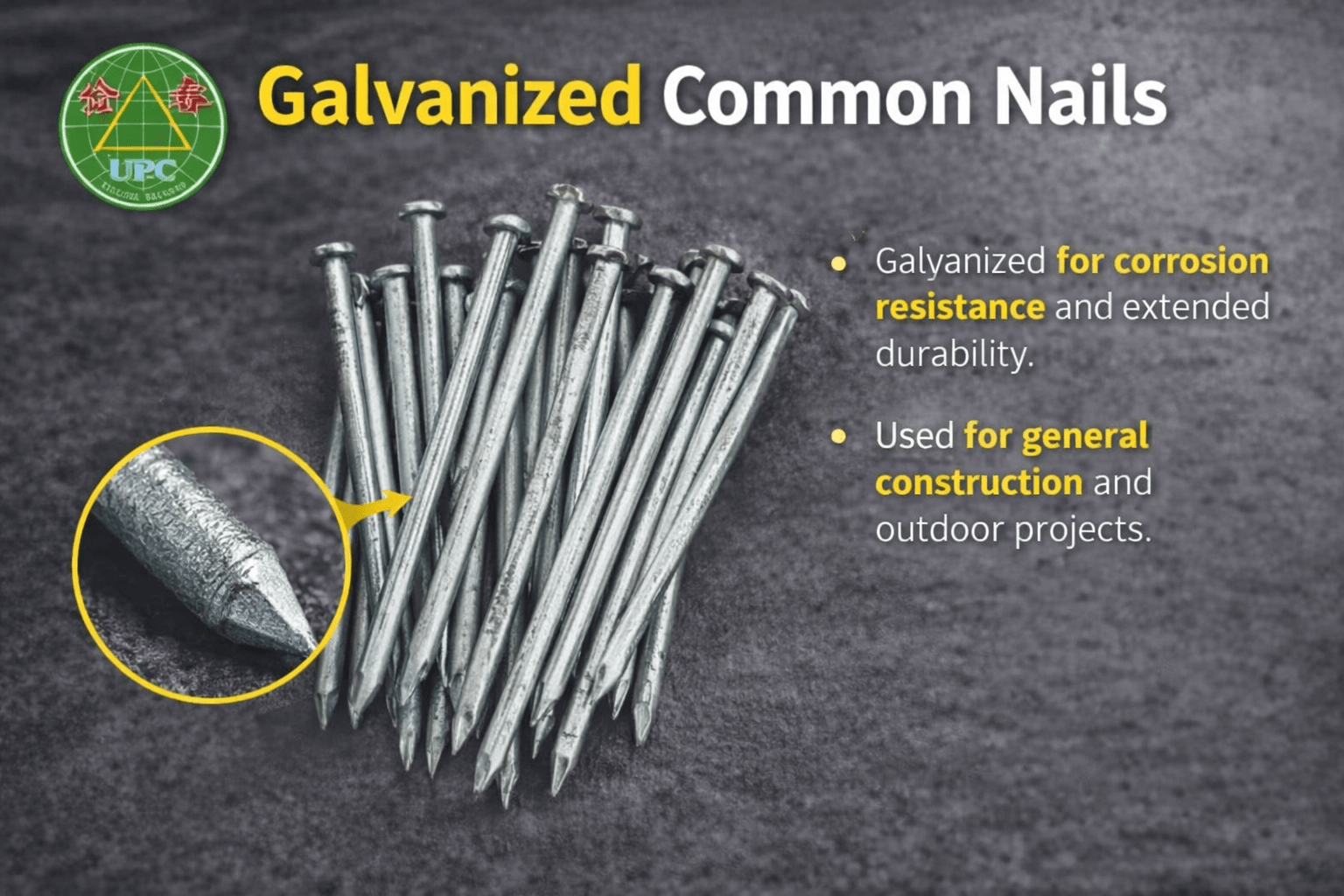
What Are Galvanized Nails?
Galvanized nails are coated with a layer of zinc, which provides protection against rust and corrosion. The zinc acts as a barrier between the steel and the environment, significantly extending the life of the nail.
There are two main types of galvanization:
- Hot-dip galvanized (HDG) – nails are dipped into molten zinc for a thick, durable coating
- Electro-galvanized (EG) – a thinner zinc layer is applied using an electroplating process
Key Characteristics
- Corrosion-resistant zinc coating
- Dull or matte gray appearance (HDG) or smoother finish (EG)
- Suitable for outdoor and humid environments
Advantages of Galvanized Nails
Excellent Corrosion Resistance
The zinc coating protects the steel core from moisture, preventing rust even in challenging conditions. This makes galvanized nails ideal for exterior applications.
Long-Term Durability
Hot-dip galvanized nails, in particular, offer long-lasting protection, even in environments exposed to rain, humidity, or treated wood.
Compatibility with Treated Lumber
Modern pressure-treated wood often contains chemicals that can accelerate corrosion. Galvanized nails are specifically designed to resist these effects.
Limitations
- Higher cost compared to bright nails
- Slightly rougher surface (especially HDG) may affect appearance in finish work
- Not always necessary for indoor applications
Common Applications
Galvanized common nails are widely used in:
- Outdoor construction
- Decking and fencing
- Roof decking and siding
- Structural framing exposed to moisture
- Coastal or high-humidity environments
They are essential for projects where durability and weather resistance are critical.
Coated Common Nails
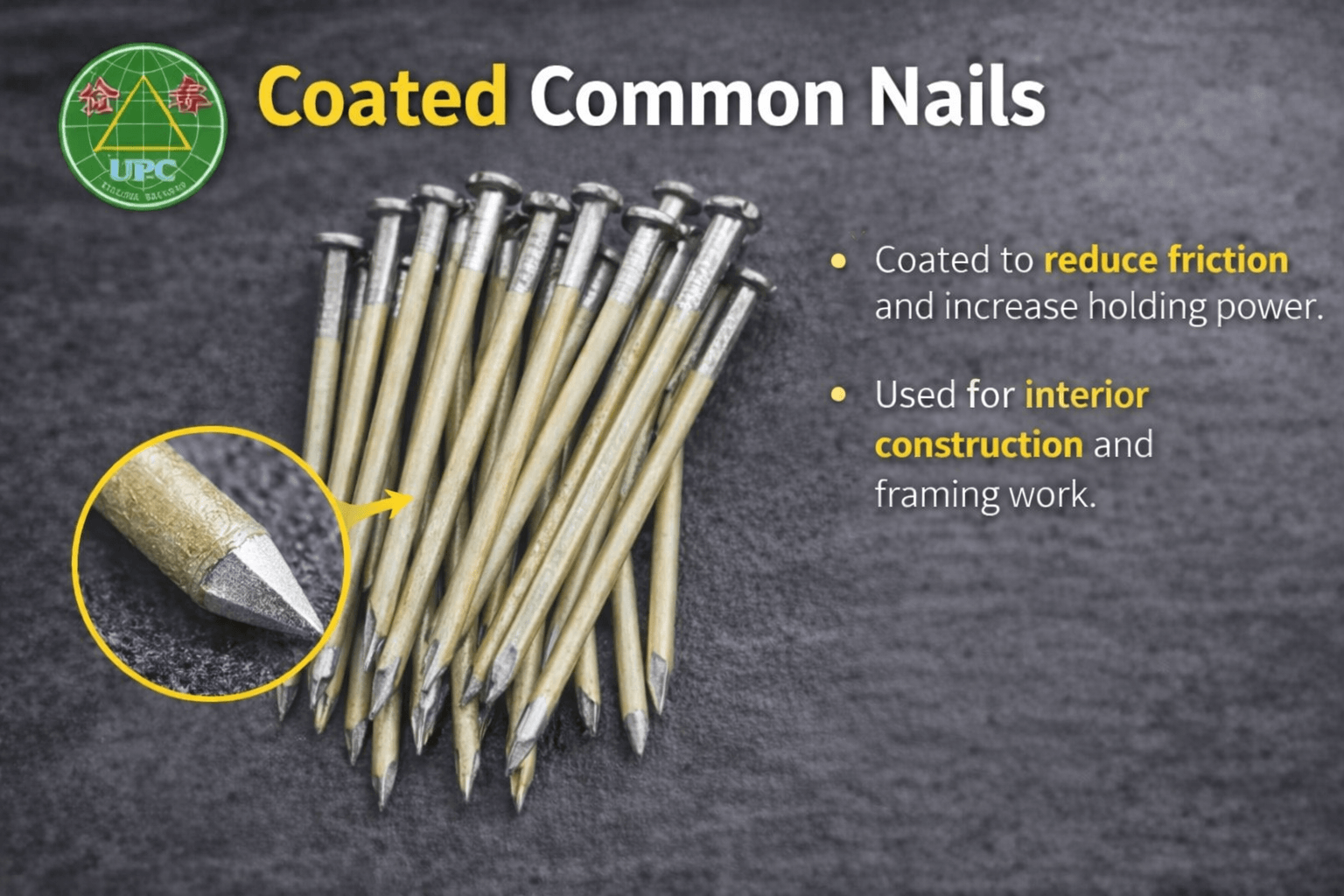
What Are Coated Nails?
Coated common nails are treated with special surface coatings, such as vinyl, resin, or other polymers, designed to enhance performance.
Unlike galvanized nails, which focus on corrosion resistance, coated nails are primarily engineered to improve holding power and driving efficiency.
Key Characteristics
- Thin layer of adhesive or friction-enhancing material
- Often slightly glossy or tinted appearance
- Designed to react with heat generated during driving
Advantages of Coated Nails
Increased Holding Power
When driven into wood, the coating can soften due to frictional heat and act like an adhesive. This creates a stronger bond between the nail and the wood fibers, significantly improving withdrawal resistance.
Reduced Splitting
The smoother driving process helps reduce the risk of wood splitting, especially in softer materials.
Improved Driving Performance
Coated nails often penetrate wood more easily, reducing the effort required and improving efficiency when using nail guns.
Limitations
- May not provide sufficient corrosion resistance unless combined with galvanization
- Slightly higher cost than bright nails
- Performance depends on proper installation
Common Applications
Coated common nails are commonly used in:
- Framing and structural connections
- Subfloor installation
- Sheathing and decking
- High-performance construction where strong holding power is required
They are especially valuable in applications where nail withdrawal could compromise structural integrity.
Comparing Bright, Galvanized, and Coated Nails
Understanding the differences between these finishes helps builders choose the most appropriate option for each project.
| Feature | Bright Nails | Galvanized Nails | Coated Nails |
|---|---|---|---|
| Corrosion Resistance | Low | High | Moderate (unless combined) |
| Holding Power | Standard | Standard | Enhanced |
| Cost | Low | Medium to High | Medium |
| Best Environment | Dry indoor | Outdoor / влажный | Structural / high-load |
| Appearance | Shiny | Matte gray | Slightly glossy |
Each finish serves a specific purpose, and the choice depends on environmental conditions and performance requirements.
How to Choose the Right Nail Finish
Selecting the correct surface finish involves evaluating several factors:
1. Environmental Conditions
If the nail will be exposed to moisture, humidity, or outdoor elements, galvanized nails are the best choice.
2. Structural Requirements
For applications requiring strong holding power, such as framing or subflooring, coated nails offer improved performance.
3. Budget Considerations
For indoor projects with minimal exposure, bright nails provide a cost-effective solution.
4. Material Compatibility
When working with treated lumber, it is essential to use galvanized nails to prevent chemical corrosion.
Best Practices for Storage and Handling
Regardless of the finish, proper storage helps maintain nail quality:
- Store nails in a dry, well-ventilated area
- Avoid exposure to moisture before use
- Keep coated nails protected to preserve their performance properties
- Use appropriate packaging to prevent damage during transportation
Proper handling ensures that the nails perform as intended on the job site.
Conclusion
The surface finish of common nails plays a vital role in determining their performance, durability, and suitability for different construction environments. Whether it is the affordability of bright nails, the corrosion resistance of galvanized nails, or the enhanced holding power of coated nails, each type offers unique advantages.
By understanding the characteristics and applications of these finishes, builders and contractors can make informed decisions that improve construction quality and longevity. Selecting the right nail finish not only ensures reliable fastening but also helps prevent costly repairs and structural issues in the future.
In today’s construction industry, attention to detail is essential—and choosing the appropriate nail finish is a small but critical step toward building stronger, safer, and more durable structures.
Contact information
UNITED NAIL PRODUCTS CO., LTD
Address: 16A8, Tra Noc Industrial Zone 1, Tra Noc Ward, Binh Thuy District, Can Tho City, VietNam
Phone: (+84) 986 831838; (+84) 292 242165
Email: sales5@unitednail.com
Thank you for reading this article, hope the information is useful to you.