


In reinforced concrete construction, strength is everything. From towering skyscrapers to residential foundations, the structural integrity of a building depends on the proper positioning and stability of reinforcing bars (rebar). While rebar provides the primary structural strength, it is the black annealed tie wire that ensures those steel bars remain securely fastened during placement and concrete pouring.
One of the most important technical properties that determines the performance of black annealed tie wire is tensile strength. Understanding tensile strength is essential for contractors, procurement managers, distributors, and manufacturers who want to ensure quality, safety, and cost-efficiency in construction projects.
This article explores what tensile strength means, how it applies to black annealed tie wire, why it matters in rebar binding, and how manufacturers control this critical property to meet global construction standards.
MỤC LỤC BÀI VIẾT
What Is Tensile Strength?

Tensile strength refers to the maximum amount of stress a material can withstand while being stretched or pulled before breaking. It is typically measured in megapascals (MPa) or newtons per square millimeter (N/mm²).
For tie wire used in rebar binding, tensile strength determines:
How much pulling force the wire can resist
Whether it can hold rebar tightly in position
How it behaves during twisting and tying
Its resistance to snapping under jobsite stress
If tensile strength is too low, the wire may break during tying. If it is too high, the wire may become stiff and difficult to twist. Therefore, the key is achieving the right balance between strength and flexibility.
Why Tensile Strength Matters in Rebar Binding
In construction sites, black annealed tie wire is used to fasten intersecting rebar at critical points. These ties must hold the reinforcement cage firmly in place until concrete is poured and fully set.
Here’s why tensile strength plays a crucial role:
1. Preventing Wire Breakage During Tying
When workers twist tie wire manually or with automatic rebar tying tools, the wire experiences tension and torsion. If tensile strength is insufficient, the wire may snap mid-tie, slowing down productivity and increasing material waste.
Proper tensile strength ensures smooth tying without frequent breakage.
2. Maintaining Structural Alignment
Rebar must remain in exact position to maintain structural integrity. During concrete pouring, vibration, and movement on-site, tie wires experience stress.
Adequate tensile strength ensures that:
Rebars remain fixed
Spacing and alignment are maintained
The reinforcement cage does not shift
3. Ensuring Jobsite Efficiency
Contractors prefer tie wire that is strong yet workable. Wire that balances tensile strength and ductility:
Reduces tying time
Minimizes waste
Improves worker productivity
In large infrastructure projects, even small improvements in tying efficiency can result in significant cost savings.
The Role of Annealing in Tensile Strength
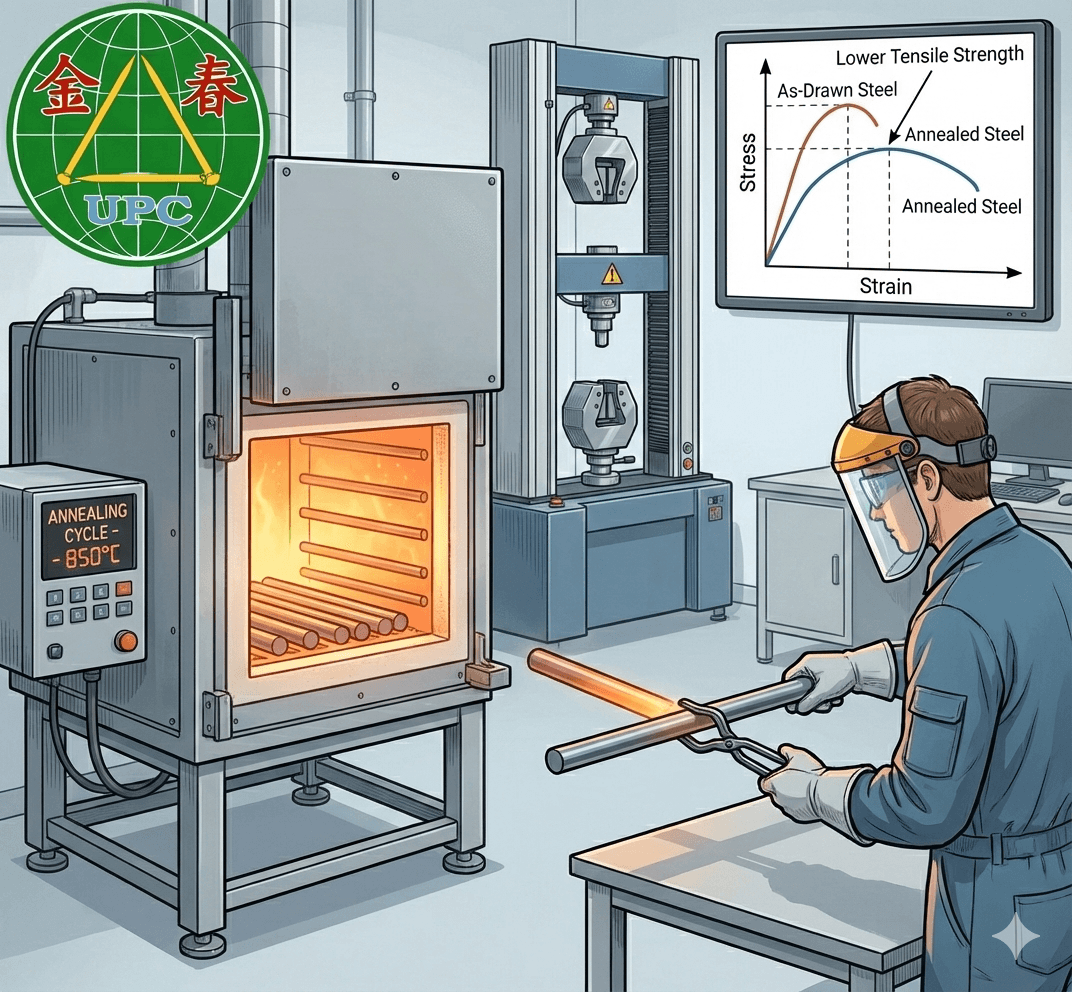
Black annealed tie wire is produced through a process called annealing, which involves heating low-carbon steel wire to a specific temperature and allowing it to cool slowly.
This process changes the internal structure of the steel, affecting:
Tensile strength
Flexibility
Ductility
Resistance to cracking
Before Annealing
Cold-drawn wire typically has higher tensile strength but is more brittle. It may break easily during twisting.
After Annealing
Annealing reduces hardness and slightly lowers tensile strength, but significantly improves flexibility and ductility. This makes the wire easier to tie without snapping.
The key is controlling the annealing temperature and duration to achieve optimal tensile properties.
Ideal Tensile Strength Range for Black Annealed Tie Wire
Although specifications vary by market and customer requirements, black annealed tie wire commonly falls within a tensile strength range of approximately:
350–550 MPa
Within this range:
Lower values offer greater flexibility
Higher values provide stronger holding capacity
Manufacturers must carefully control production to maintain consistent tensile strength across batches. Inconsistent tensile strength can lead to uneven tying performance and customer dissatisfaction.
Balancing Tensile Strength and Ductility
Tensile strength alone does not define wire performance. It must be considered alongside ductility—the ability of a material to deform without breaking.
For rebar binding, ideal tie wire should:
Twist easily
Bend without cracking
Withstand pulling force
Maintain knot integrity
A wire with excessively high tensile strength but low ductility may resist stretching but break during twisting. Conversely, a wire that is too soft may stretch excessively and loosen over time.
This balance is achieved through:
Precise carbon content control
Accurate annealing temperature
Controlled cooling process
Strict quality inspection
Factors That Influence Tensile Strength
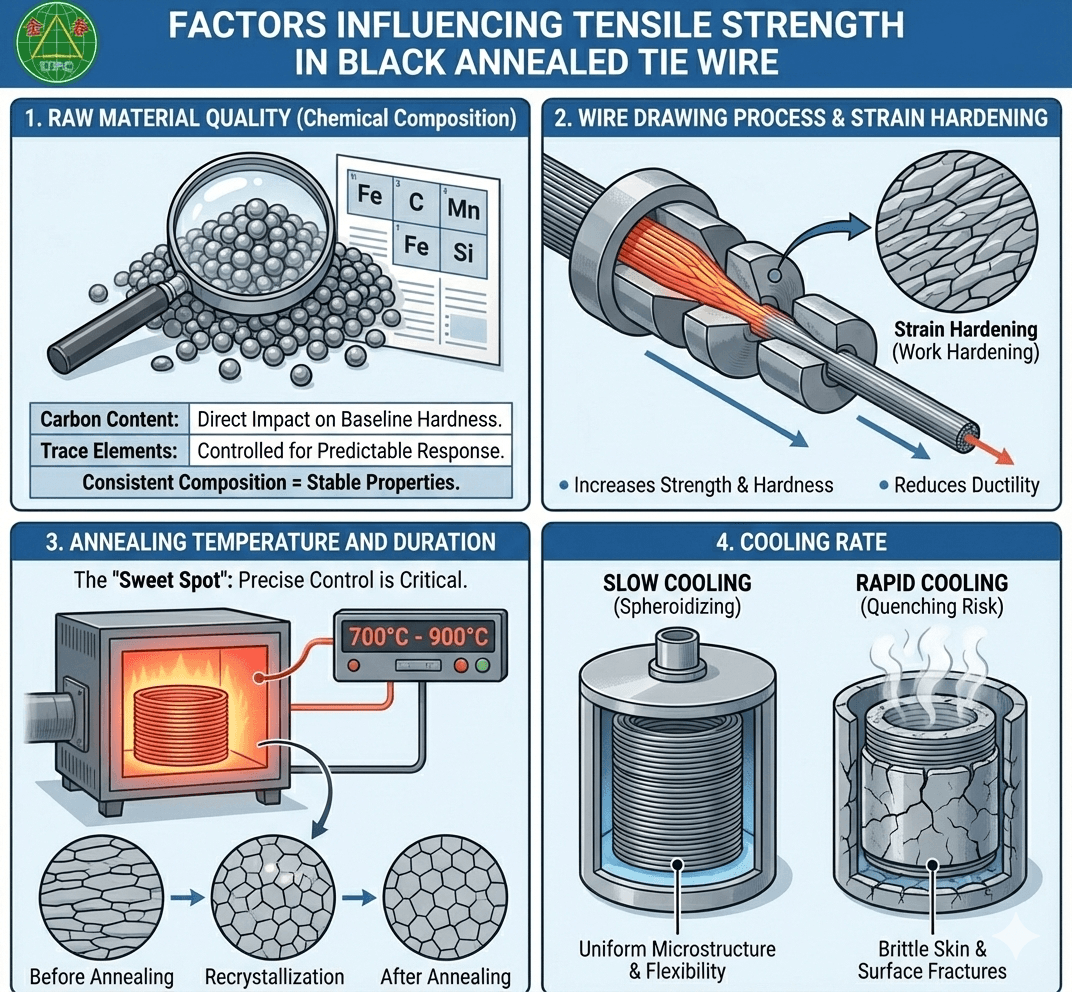
Several production factors directly impact tensile strength in black annealed tie wire.
1. Raw Material Quality
The chemical composition of low-carbon steel plays a fundamental role. Consistent carbon content ensures predictable tensile properties.
High-quality raw steel provides:
Stable mechanical properties
Uniform microstructure
Better performance consistency
2. Wire Drawing Process
During wire drawing, steel rod is pulled through dies to reduce diameter. This process increases tensile strength through strain hardening.
If drawing is not controlled properly, tensile strength may become too high before annealing.
3. Annealing Temperature and Duration
Precise control of furnace temperature is critical. Over-annealing may make wire too soft. Under-annealing may leave wire too hard.
Advanced manufacturers use:
Temperature monitoring systems
Controlled atmosphere furnaces
Batch consistency checks
4. Cooling Rate
Slow cooling ensures uniform microstructure formation. Rapid or uneven cooling can create inconsistent tensile zones within the same coil.
How Tensile Strength Is Tested
Reliable manufacturers conduct tensile testing using specialized equipment. The test involves:
Clamping a sample wire
Applying increasing pulling force
Measuring maximum stress before breakage
The result determines whether the batch meets required standards.
Additional quality checks may include:
Elongation testing
Twist test
Surface inspection
Diameter measurement
Testing ensures that each coil performs consistently under jobsite conditions.
Global Standards and Market Expectations
Different markets may specify mechanical requirements for tie wire. While tie wire is not always subject to the same strict structural standards as rebar, reputable manufacturers align production with international best practices.
Buyers in regions such as:
North America
Europe
Australia
Middle East
often expect documented quality control procedures and mechanical test reports.
Meeting these expectations strengthens supplier credibility and enhances long-term partnerships.
Impact of Tensile Strength on Automatic Rebar Tying Tools
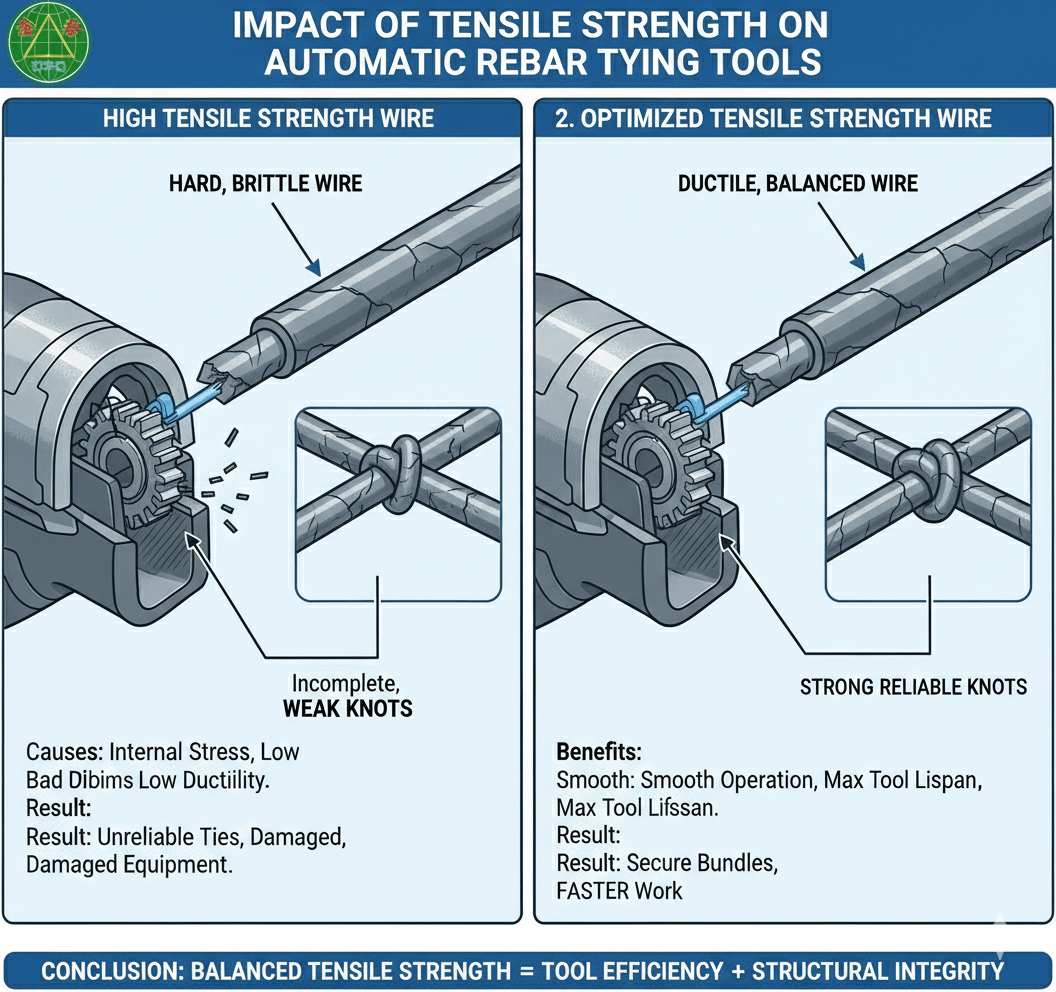
With the increasing use of automatic tying machines, tensile strength control has become even more important.
Automatic tools apply consistent torque and tension. If wire tensile strength is inconsistent:
Machines may jam
Knots may break
Productivity may decrease
Manufacturers supplying wire for machine use must ensure:
Uniform tensile strength
Smooth surface finish
Consistent diameter tolerance
This precision improves compatibility with modern construction equipment.
Common Problems Caused by Poor Tensile Control
When tensile strength is not properly controlled, several issues may arise:
1. Frequent Wire Breakage
Workers experience interruptions and material waste.
2. Loose Knots
Rebars shift during concrete pouring.
3. Excessive Stiffness
Workers struggle to twist wire efficiently.
4. Inconsistent Performance
Different coils behave differently on the same project.
These issues can compromise both productivity and structural reliability.
How Quality Manufacturers Maintain Consistency
To ensure reliable tensile strength, professional manufacturers implement:
Strict raw material selection
Standardized drawing procedures
Controlled annealing cycles
Batch-by-batch mechanical testing
Continuous production monitoring
Consistency builds trust. Contractors and distributors prefer suppliers who deliver predictable performance with every shipment.
The Business Advantage of Controlled Tensile Strength
For distributors and importers, tensile strength consistency offers commercial benefits:
Reduced customer complaints
Lower return rates
Stronger brand reputation
Higher repeat order volume
For contractors, it means:
Faster tying
Fewer delays
Safer reinforcement structures
Improved cost efficiency
In competitive global markets, technical reliability becomes a major differentiator.
Looking Ahead: The Future of Tie Wire Performance
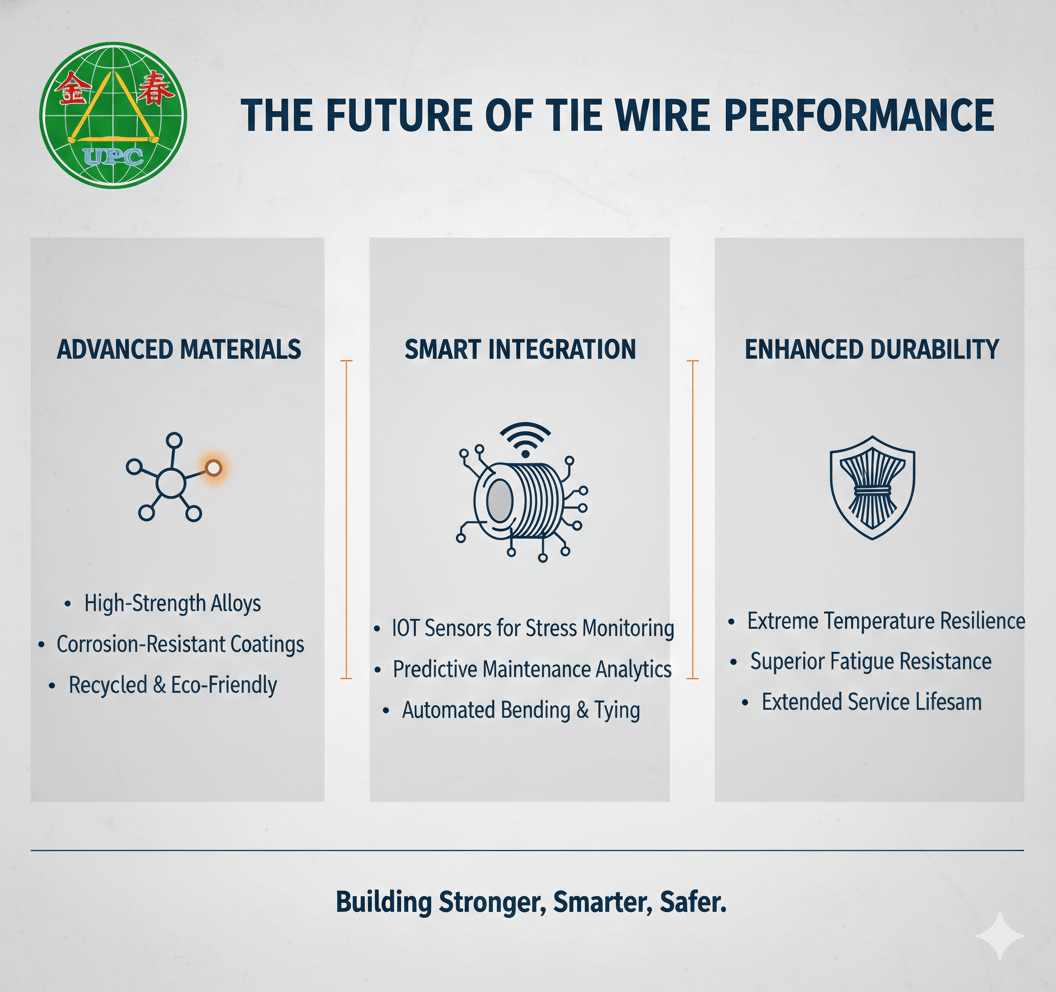
As construction technology evolves, expectations for tie wire performance continue to rise. High-rise buildings, infrastructure megaprojects, and prefabrication systems require materials that meet strict mechanical demands.
Future trends include:
More automated tying solutions
Higher consistency standards
Increased demand for certified mechanical properties
Greater transparency in quality documentation
Manufacturers who understand and control tensile strength will remain competitive in this evolving landscape.
Conclusion
Tensile strength is one of the most critical mechanical properties in black annealed tie wire. It determines how the wire performs during tying, how securely it holds rebar in place, and how efficiently construction crews can work on-site.
The ideal tie wire achieves a careful balance between strength and flexibility—strong enough to resist pulling forces, yet ductile enough to twist without breaking. Achieving this balance requires precision in raw material selection, wire drawing, annealing, cooling, and quality testing.
For contractors, distributors, and procurement managers, understanding tensile strength helps in selecting reliable suppliers and ensuring consistent jobsite performance.
In a global construction environment where safety, efficiency, and quality are non-negotiable, properly controlled tensile strength is not just a technical specification—it is a foundation for trust, durability, and long-term success.
Contact information
UNITED NAIL PRODUCTS CO., LTD
Address: 16A8, Tra Noc Industrial Zone 1, Tra Noc Ward, Binh Thuy District, Can Tho City, VietNam
Phone: (+84) 986 831838; (+84) 292 242165
Email: sales5@unitednail.com
Thank you for reading this article, hope the information is useful to you